

Catch up with food and beverage industry news from the world
Provided by AGP
Shane Vithana Introduces AskSLIP, a State-Aware AI Platform Built for Neurodivergent Thinking and Real-World Decisions
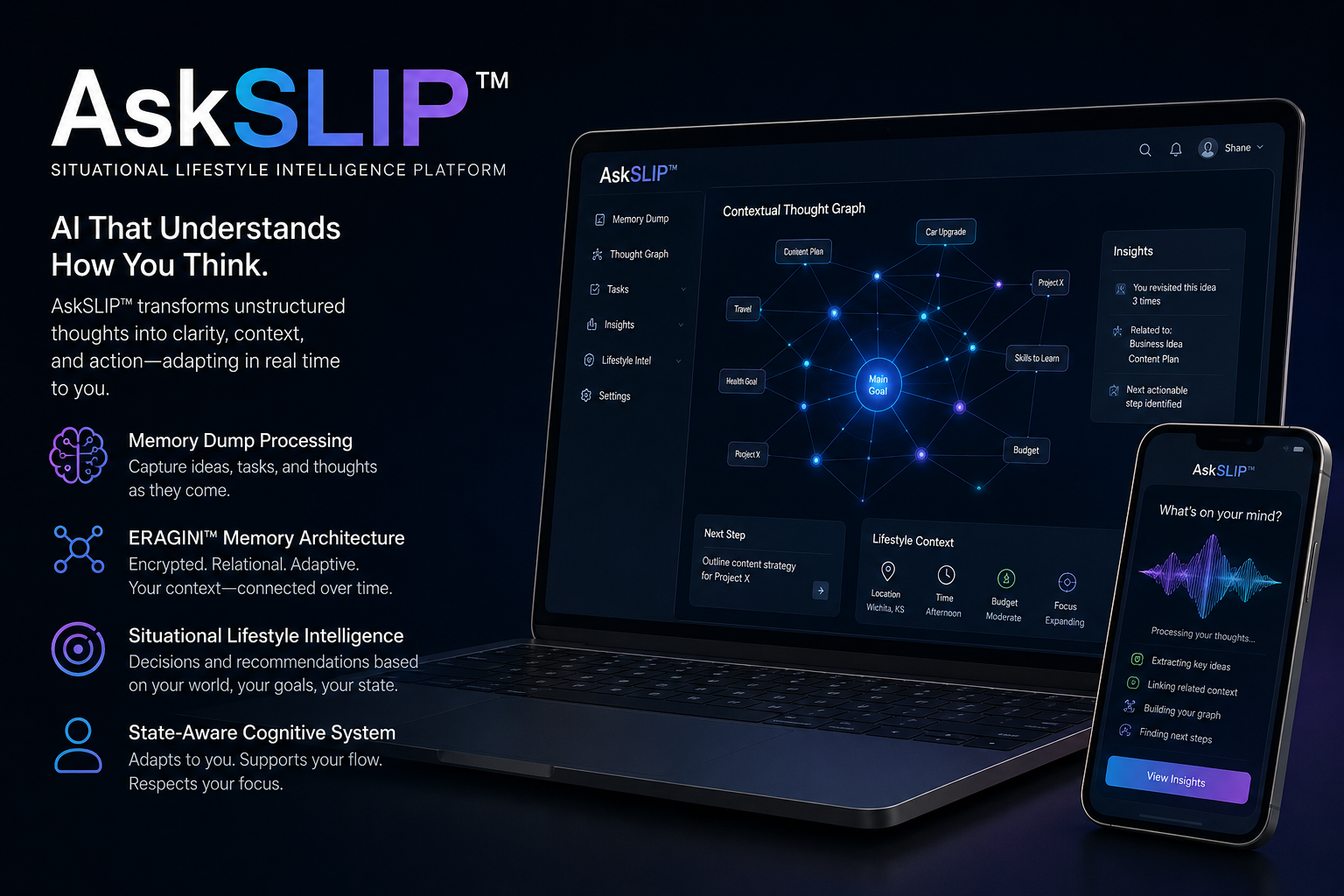
AskSLIP™ interface showcasing contextual thought graphs and real-time memory structuring powered by ERAGIN™, designed to transform unstructured thinking into actionable outcomes.
Ask SLIP™ transforms memory dumps, mental states, and real-world context into structured action using situational lifestyle intelligence.
WICHITA, KS, UNITED STATES, May 7, 2026 /EINPresswire.com/ -- A new approach to artificial intelligence is taking shape, one designed to align with how people think rather than requiring them to adapt to rigid systems.Shane Vithana, a systems developer and co-founder of Tergado, has introduced AskSLIP™ (Situational Lifestyle Intelligence Platform), a state-aware AI platform built to convert unstructured thoughts, shifting clarity, and real-world context into usable outcomes.
Built on a neurodivergent operating system framework and powered by ERAGIN™ (Encrypted Relational Adaptive Graph Intelligence Node), AskSLIP™ moves away from conventional AI assistants that depend on linear prompts and structured workflows. The platform is designed for users who process information in bursts, patterns, and fragments, including those who identify as neurodivergent, such as individuals with ADHD and AuDHD.
“Most systems assume clarity before action,” Vithana said. “AskSLIP™ is designed to work from wherever the user actually is and help translate that into something actionable.”
At its core is a memory processing system that accepts unstructured input, often referred to as a memory dump, without requiring prior organization. The platform extracts ideas, tasks, and contextual signals, identifies recurring patterns, and connects related concepts across time. It can supplement gaps with external information and convert raw input into structured outputs, allowing users to move from fragmented thinking to actionable steps.
The approach targets a common issue among users who experience rapid shifts in attention or focus, the loss of continuity between ideas, tasks, and prior work. By structuring unorganized input into connected units of meaning, the system is intended to preserve context and reduce the need to repeatedly restart cognitive processes.
AskSLIP™ adapts in real time to how a user is thinking. When inputs are fragmented, it groups and organizes them. As focus increases, it expands detail and supports execution. When clarity declines, it simplifies output and highlights the next relevant step. The system adjusts its behavior based on cognitive context rather than enforcing a fixed interface.
A central component of the platform is ERAGIN™, a memory architecture designed to provide persistent, user-controlled context through a structured node-based system. ERAGIN™, defined as an Encrypted Relational Adaptive Graph Intelligence Node, converts each user input into interconnected nodes within a dynamic relational graph. These nodes represent ideas, tasks, context, and time signals, forming a structure that evolves as information develops.
Within this structure, relationships between nodes are established based on context, similarity, and usage patterns. This allows the system to move beyond keyword retrieval and perform contextual linking across past and present inputs. Information is not stored as isolated entries, but as part of a broader cognitive framework that supports continuity and recall.
ERAGIN™ incorporates encrypted data handling to ensure personal data is not used for external model training without user control. Its adaptive layer reinforces relevant connections based on interaction patterns while reducing less useful links over time. This creates a memory system that evolves alongside the user rather than remaining static.
The platform also supports what Vithana describes as memory-to-memory retrieval, where new inputs are matched against existing nodes within the graph. Instead of treating each query independently, the system draws from stored context, enabling responses that reflect ongoing patterns, prior decisions, and accumulated information.
The architecture differs from traditional AI systems that rely primarily on language-based inference. By introducing a structured graph-based memory layer, AskSLIP™ is designed to maintain continuity, improve contextual awareness, and reduce fragmentation in user workflows. This approach positions memory as a core component of intelligence rather than a secondary feature.
Beyond task management, AskSLIP™ integrates Situational Lifestyle Intelligence, combining cognitive awareness with environmental and contextual factors. The platform evaluates inputs such as location, time constraints, budget, and personal interests including cars, travel, food, and technology, along with the user’s current cognitive condition.
This allows the system to generate context-aware decisions and recommendations rather than static lists or generic outputs. By combining internal cognitive signals with external situational data, AskSLIP™ is intended to provide guidance that is both relevant and usable in real-world scenarios.
The platform also builds a continuously evolving contextual graph of user activity, referred to as a Contextual Thought Graph. Within this structure, previously explored ideas can be surfaced, related concepts can be linked, and overlapping patterns can be identified across sessions. This is intended to reduce repetition and cognitive fatigue while helping users maintain progress over time.
AskSLIP™ is positioned as a new category of software described as State-Aware Cognitive Systems. Rather than functioning as a chatbot or traditional productivity application, it operates as a cognitive layer that connects input, memory, and decision-making into a unified system.
The platform is currently in early-stage development. Initial prototypes focus on memory processing, adaptive interaction, relational graph architecture, and context-aware decision modeling. Future development is expected to expand into adaptive scheduling, lifestyle optimization, and deeper integration with external systems and data sources.
The names AskSLIP™ and ERAGIN™ are being introduced as identifiers for the platform and its underlying architecture. Related concepts, including State-Aware Cognitive Systems, Memory Dump Processing, Relational Graph Memory, and Contextual Thought Graphs, are presented as part of the system’s core framework.
Vithana, based in Wichita, Kansas, has spent more than a decade working on analytical systems, simulation models, and human-machine interaction. His recent work has focused on building systems that align more closely with real-world human behavior, particularly in areas involving non-linear thinking, adaptive decision-making, and cognitive support technologies.
Press Secretary
Nox Foundation
email us here
Legal Disclaimer:
EIN Presswire provides this news content "as is" without warranty of any kind. We do not accept any responsibility or liability for the accuracy, content, images, videos, licenses, completeness, legality, or reliability of the information contained in this article. If you have any complaints or copyright issues related to this article, kindly contact the author above.
