

Soybean Oil Market to Surpass USD 77 Billion by 2032 by 2032 at 4% CAGR: Biofuel Mandates Driving Industry Expansion
Soybean Oil Market
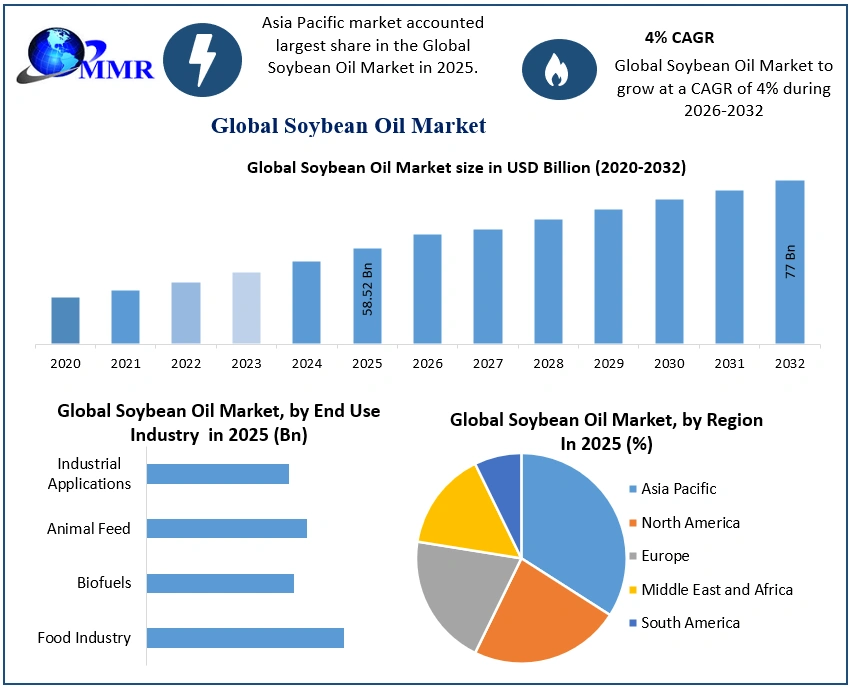
Soybean Oil Market valued at USD 58.52 Billion in 2025, projected to reach USD 77 Billion by 2032 at 4% CAGR.
Is soybean oil the new crude? Biofuel mandates are flipping the global energy hierarchy overnight.”
ROCKVILLE , MD, UNITED STATES, March 27, 2026 /EINPresswire.com/ -- Maximize Market Research, a leading global business intelligence firm, announced the release of its comprehensive study on the Global Soybean Oil Market. The industry, valued at USD 58.52 Billion in 2025, is projected to undergo a sophisticated structural pivot, reaching nearly USD 77 Billion by 2032 at a steady 4.9% CAGR.— Maximize Market Research
Get Full PDF Sample Copy of Report: (Including Full TOC, List of Tables & Figures, Chart) @ https://www.maximizemarketresearch.com/request-sample/125638/
This growth is being propelled by a historic decoupling of soybean oil from traditional food based valuations. The market is navigating a Perfect Storm of geopolitical volatility and aggressive new environmental mandates. While food service remains a core pillar, the industry’s trajectory is now fundamentally tethered to the global energy transition, specifically the rapid scaling of the biomass-based diesel and Sustainable Aviation Fuel (SAF) sectors.
The Energy Pivot: USDA Forecasts 17.3% Surge in Soybean Oil for Biofuel Amid 45Z Tax Credit Implementation
The primary engine is the unprecedented integration of agriculture into the global energy grid. According to the USDA’s Outlook, the volume of soybean oil dedicated to biofuel production is expected to surge by 17.3% in the 2026-27 marketing year.
This acceleration is driven by the full implementation of the U.S. 45Z Clean Fuel Production Credit, which has replaced older blenders credits with a carbon-intensity (CI) based model. For the first time, soybean oil is being valued not just as a commodity, but as a Low-Carbon Feedstock. The North American Ringfence a policy shift requiring exclusive use of domestic feedstocks for federal tax eligibility has effectively doubled the credit value for soy-based biofuels to approximately USD 0.50 per gallon. This legislative milestone is forcing a massive rerouting of global trade flows, as domestic refiners move to secure U.S. and Canadian soybean oil over cheaper, imported waste fats.
Industrial and Food Innovation: High-Oleic Solutions and Bio-Based Polymers Redefine the Soybean Oil Value Chain
While energy dominates headlines, the Industrial & Food Innovation segment is the quiet architect of the market. A surge in High-Oleic Soybean Oil adoption, which is projected to capture 12% of the industrial frying market due to its superior oxidative stability and heart-healthy profile.
In the industrial sector, soybean oil is increasingly replacing petroleum-based formaldehyde in wood adhesives and resins. High-tech Soy-Polymers are now being used by major automotive manufacturers for interior seating foam and tires, driven by corporate ESG mandates. Furthermore, the Precision Breeding initiatives has allowed for the development of carbon-negative soy varieties. These innovations provide a critical buffer against price volatility, ensuring that soybean oil remains a versatile, sustainable alternative to synthetic chemicals across the global manufacturing landscape.
Regional Market Analysis: How Infrastructure Bottlenecks and Export Mandates are Shifting the US-Brazil Soybean Oil Balance
The global landscape is currently defined by a Logistics vs. Supply war between the two largest producers. Brazil is harvesting a record 180 million metric ton soybean crop, putting immense downward pressure on global export prices. However, Brazilian exporters face severe internal freight hikes and port congestion at Santos, driven by rising bunker fuel costs.
Conversely, the U.S. has transitioned into a processing powerhouse. While U.S. exports are projected to recover to 1.7 billion bushels, the domestic focus has shifted to the Crush Spread efficiency. U.S. crushers are prioritizing domestic meal and oil demand to satisfy the Renewable Volume Obligations (RVOs). This regional divergence positioning Brazil as the global agricultural hub and the United States as the world's premier biorefinery represents a fundamental structural shift driving the industry’s expansion.
Soybean Oil Market Key Players
Archer Daniels Midland Company (ADM)
Bunge Limited
Cargill, Incorporated
Louis Dreyfus Company B.V.
Wilmar International Limited
DuPont
Unilever plc
AMAGGI Group
SunOpta, Inc.
Ruchi Soya Industries Limited
Kerry Group PLC
FUJI OIL
Aceitera General Deheza
Patanjali Foods
ACH Food Companies
Get Full PDF Sample Copy of Report: (Including Full TOC, List of Tables & Figures, Chart) @ https://www.maximizemarketresearch.com/request-sample/125638/
Soybean Oil Market Segmentation: Analyzing the Structural Shift Toward High-Oleic and Industrial-Grade Refined Oils
The trajectory is defined by three distinct structural pillars. First, Refined Soybean Oil continues to underpin the market, as its 90% purity level becomes the mandatory standard for the burgeoning HVO (Hydrotreated Vegetable Oil) sector. However, the most significant value-add is coming from High-Oleic Soybean Oil, which is projected to grow at a 7.4% CAGR as food processors swap out traditional fats for heart-healthy, high-stability alternatives.
From a logistics perspective, the industry is witnessing a Model Inversion. Direct Sales (B2B) have surpassed traditional retail channels in volume as energy giants like Chevron and Bunge establish vertically integrated crush-to-fuel supply chains. This shift is most prominent in the Asia-Pacific region, which currently commands a 46.8% global share, driven by industrialization in India and China. By focusing on these high-growth segments Biofuels, Industrial Applications, and Refined Grade oils operators are securing a dominant position in the global trade landscape.
By Type
Refined Soybean Oil
Crude Soybean Oil
High-Oleic Soybean Oil
By Distribution Channel
Supermarkets & Hypermarkets
Convenience Stores
Online Retail
Direct Sales (B2B)
By End-Use Industry
Food Industry
Biofuels
Animal Feed
Industrial Applications
Get access to the full description of the report @ https://www.maximizemarketresearch.com/market-report/soybean-oils-market/125638/
Analyst Perspective
The soybean oil landscape is defined by a fundamental Value-Extraction phase. We are moving beyond the era of simple commodity trading into a sophisticated, data-driven supply chain. The most successful operators are those leveraging AI-integrated Crush Spread analytics to mitigate the 12% price volatility. By transitioning from generic crude oil to specialized High-Oleic and carbon-indexed feedstocks, producers are effectively shielding themselves from inflationary pressures and securing long-term premiums in the Sustainable Aviation Fuel (SAF) and high-end food processing sectors.
Regulatory & ESG: The Compliance Gateway
The industry’s trajectory is increasingly defined by a shift toward stringent environmental mandates and carbon-accounting transparency. The global implementation of the EU Deforestation Regulation (EUDR) and the U.S. 45Z Clean Fuel Tax Credit has transformed Traceability into the market’s primary currency. Current market data reveals that soybean oil backed by a verified Low Carbon Intensity (CI) Score is commanding a 5% price premium over conventional feedstocks. As global refineries and food conglomerates adopt Digital Passports to track every metric ton from farm to terminal, the ability to provide auditable proof of sustainable sourcing has shifted from an elective corporate goal to an absolute requirement for market entry.
FAQ’s
What is the projected size of the Soybean Oil Market by 2032?
Ans: The market is expected to reach nearly USD 77 Billion by 2032, growing at a 4% CAGR from its 2025 baseline of USD 58.52 Billion.
What is driving the demand for High-Oleic Soybean Oil?
Ans: Growth is fueled by the food industry’s shift toward trans-fat-free, high-stability frying solutions that offer a 30% longer shelf life than conventional oils.
How are biofuel mandates impacting prices in 2026?
Ans: The USDA’s 17.3% surge forecast for biofuel feedstock, combined with the U.S. 45Z tax credits, is creating a supply-side squeeze that supports long-term price floors.
Related Reports
Soybean Rust Control Market: https://www.maximizemarketresearch.com/market-report/soybean-rust-control-market/193959/
Soybean Meal Market: https://www.maximizemarketresearch.com/market-report/global-soybean-meal-market/107035/
Non-GMO Soybean Market: https://www.maximizemarketresearch.com/market-report/global-non-gmo-soybean-market/96692/
Rice Bran Oil Market: https://www.maximizemarketresearch.com/market-report/rice-bran-oil-market/220977/
Vegetable Oil Market: https://www.maximizemarketresearch.com/market-report/global-vegetable-oil-market/108821/
Top Reports:
Tungsten Carbide Market
Global Ductless Hvac System Market
About Maximize Market Research
Maximize Market Research is a global business intelligence firm empowering Fortune 500 companies across 45 countries. We provide high-impact, data-driven strategic intelligence to navigate industrial shifts and secure market dominance.
Domain Focus: Food & Beverages
Our research deciphers the critical convergence of agricultural logistics and renewable energy mandates. We analyze the intersection of carbon-intensity scoring and industrial innovation, evaluating high-value shifts in Clean Label food processing and global supply-chain resilience.
Lumawant Godage
MAXIMIZE MARKET RESEARCH PVT. LTD.
+91 96073 65656
email us here
Visit us on social media:
LinkedIn
Instagram
Facebook
X
Legal Disclaimer:
EIN Presswire provides this news content "as is" without warranty of any kind. We do not accept any responsibility or liability for the accuracy, content, images, videos, licenses, completeness, legality, or reliability of the information contained in this article. If you have any complaints or copyright issues related to this article, kindly contact the author above.
