

2036 Strategic Analysis of the Microencapsulated Food Ingredients Market: Portfolio Priorities, Adoption Trends
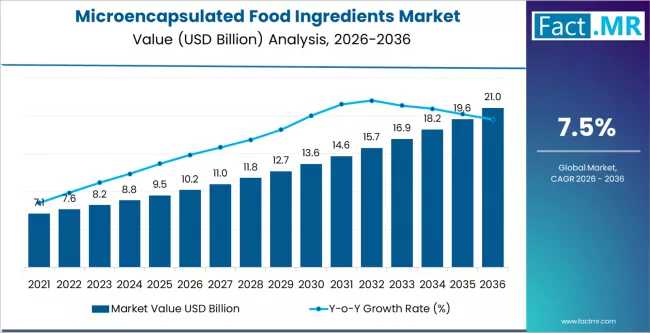
Microencapsulated Food Ingredients Market
Global Microencapsulated Food Ingredients Market Accelerates as Functional Food Demand Hits New Peaks
ROCKVILLE, MD, UNITED STATES, January 20, 2026 /EINPresswire.com/ -- The global microencapsulated food ingredients market is undergoing a fundamental transformation, driven by an intensified consumer focus on "better-for-you" products and the industrial need for enhanced ingredient stability. New data indicates the market, valued at approximately USD 8.93 billion in 2025, is poised for robust expansion as manufacturers adopt advanced delivery systems to meet the rigorous demands of the modern functional food and beverage sectors.Request for Sample Report | Customize Report |purchase Full Report - https://www.factmr.com/connectus/sample?flag=S&rep_id=13740
Answering the Market Shift: Who, What, and Why
Microencapsulation involves coating active ingredients—such as vitamins, minerals, probiotics, and enzymes—within a protective matrix or "shell." This technology serves three primary purposes:
Protection: Shielding sensitive nutrients from oxidation, moisture, and heat during processing.
Taste Masking: Neutralizing the bitter or metallic notes of minerals and omega-3 fatty acids.
Controlled Release: Ensuring that bioactives are released at specific points in the digestive tract to maximize bioavailability.
As of early 2026, the industry is witnessing a "green" revolution in wall materials. There is a marked pivot away from synthetic polymers toward biodegradable and plant-based matrices like maltodextrin, gum Arabic, and pea proteins. This shift is essential for brands seeking "clean-label" status, a key purchasing driver for Gen Z and Millennial consumers.
Strategic Regional and Sector Growth
While North America remains the largest market due to its established regulatory frameworks and high R&D investment, the Asia-Pacific region is emerging as the fastest-growing corridor. Rapid urbanization and a burgeoning middle class in China and India have spiked demand for fortified snacks and functional beverages.
Market Metric 2025 Estimate 2033 Projection
Global Market Size USD 8.93 Billion USD 16.05 Billion
Projected CAGR — 7.6% (2026–2033)
Leading Form Solid (68% share) Solid (Growth at 11%+)
Technologically, physical encapsulation methods (such as spray drying and fluidized-bed coating) continue to dominate, accounting for nearly 67% of the market share. These methods are favored for their cost-effectiveness and scalability in high-volume production environments like dairy and bakery.
Overcoming Industrial Challenges
Despite the positive outlook, the industry faces headwinds from rising raw material costs and complex regulatory landscapes. Recent trade policies and tariffs have incentivized a move toward localized production and domestic supply chain strengthening. Leading players—including BASF SE, Givaudan S.A., DSM, and International Flavors & Fragrances (IFF)—are increasingly leveraging Artificial Intelligence (AI) to optimize encapsulation yields and reduce waste, effectively neutralizing some of these inflationary pressures.
The Rise of Specialized Applications
The application of microencapsulation is expanding beyond traditional multivitamins:
Probiotics: New encapsulation techniques allow live cultures to survive the high temperatures of baking and the acidity of the stomach.
Confectionery: Encapsulated sweeteners provide a prolonged flavor release, extending the sensory experience of sugar-free gums and candies.
Alternative Proteins: Masking the earthy off-notes of plant-based proteins is becoming a major sub-sector for encapsulation specialists.
"Microencapsulation is no longer just a technical utility; it is a source of entirely new ingredient properties," states a leading industry analyst. "By 2027, the ability to control the precise release of a nutrient or flavor will be the standard baseline for any competitive functional food brand."
About the Microencapsulated Food Ingredients Sector
The microencapsulated food ingredients industry represents the intersection of food science and pharmaceutical precision. By utilizing micro-sized carriers, the industry enables the fortification of everyday foods, contributing to global health initiatives and the extension of product shelf life without the need for traditional preservatives.
To View Related Report :
Skin Care Ingredients Market
https://www.factmr.com/report/367/skin-care-ingredients-market
Mineral Ingredients Market
https://www.factmr.com/report/428/mineral-ingredients-market
Functional Dairy Ingredients Market
https://www.factmr.com/report/642/functional-dairy-ingredient-market
Food Processing Ingredients Market
https://www.factmr.com/report/846/food-processing-ingredients-market
About Us:
Fact.MR is a distinguished market research company renowned for its comprehensive market reports and invaluable business insights. As a prominent player in business intelligence, we deliver deep analysis, uncovering market trends, growth paths, and competitive landscapes. Renowned for its commitment to accuracy and reliability, we empower businesses with crucial data and strategic recommendations, facilitating informed decision-making and enhancing market positioning.
S.N.Jha
Fact.MR
+1 628-251-1583
email us here
Legal Disclaimer:
EIN Presswire provides this news content "as is" without warranty of any kind. We do not accept any responsibility or liability for the accuracy, content, images, videos, licenses, completeness, legality, or reliability of the information contained in this article. If you have any complaints or copyright issues related to this article, kindly contact the author above.
