

Inside the food basket: what is behind recent food inflation?
Prepared by Colm Bates, Friderike Kuik, Elisabeth Wieland and Zivile Zekaite
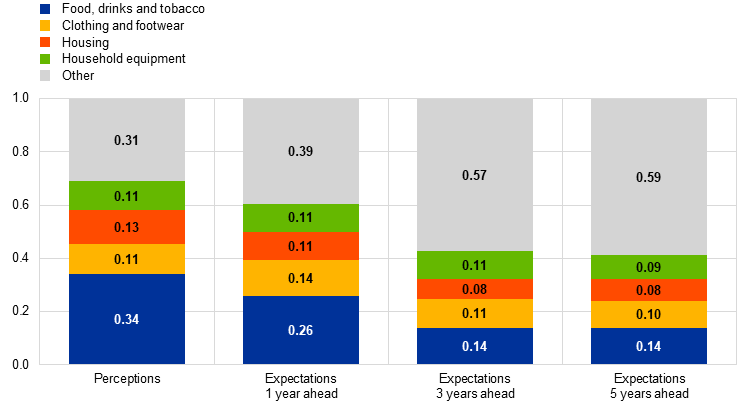
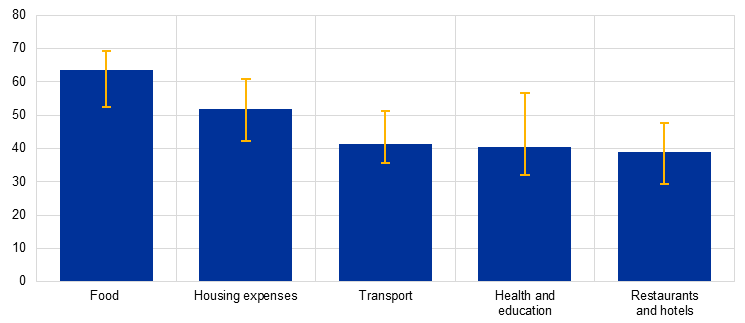
Understanding the persistent food inflation in 2025 is important, not least because food price dynamics play a significant role in consumers’ inflation perceptions and short-term inflation expectations. People pay special attention to food price developments because they purchase food frequently, it accounts for a sizeable share of their budgets and there is limited scope for substitution. This means food purchases may disproportionately influence their beliefs about overall inflation.[1] In its Consumer Expectations Survey (CES), the European Central Bank (ECB) has collected detailed information about inflation perceptions and expectations regarding major consumer basket items on a semi-regular basis since 2022. The analysis shows that perceived and expected food inflation have a relatively strong influence on overall inflation perceptions and one-year expectations (Chart A, panel a). At longer horizons, food does not play such an outsized role. Furthermore, almost two-thirds of respondents stated that food prices influence their inflation expectations, a higher share than for any other basket item (Chart A, panel b). These respondents were more likely to expect inflation above the ECB’s 2% target for the next 12 months than the remaining third. Understanding recent food price dynamics is therefore important both for monitoring overall inflation and for assessing consumers’ expectations.
Chart A
Relevance of food prices for inflation expectations
a) Relative importance of food inflation for inflation perceptions and expectations
(relative weights)
b) Top five drivers of consumer inflation expectations
(percentages, percentage share of respondents)
Sources: ECB CES, ECB calculations.
Notes: The chart in panel a) shows the relative weights of consumer basket items based on the additional explanatory power of the items in the regressions for inflation perceptions (first bar) and expectations (controlling for perceptions, remaining bars) over a regression using only fixed effects. The “Other” category includes the contributions of the items “Health”, “Transport”, “Communication”, “Recreation and culture”, “Education”, and “Restaurants and hotels”. CES data are for December 2022, January, July and December 2023, January 2024, and May and June 2025. Panel b) indicates responses to the following question in the CES: When you think about how prices in general in the country you currently live in will change over the next 12 months, which of the items listed below influence your expectations? Yellow ranges indicate the minimum and maximum shares reported across countries. “Food” refers to food and drinks, including tobacco.
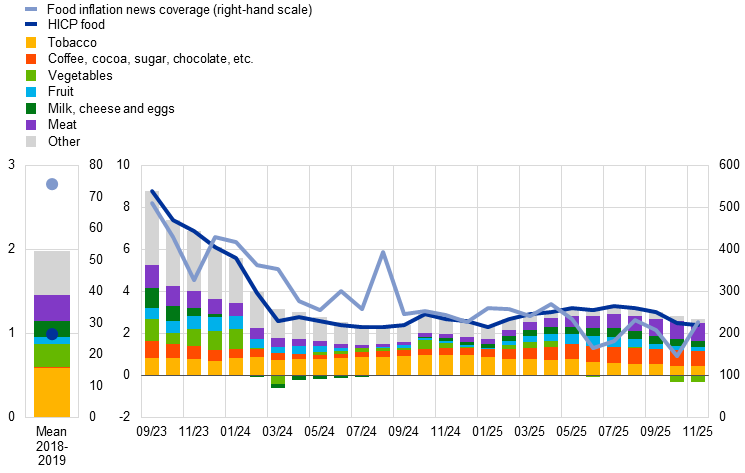
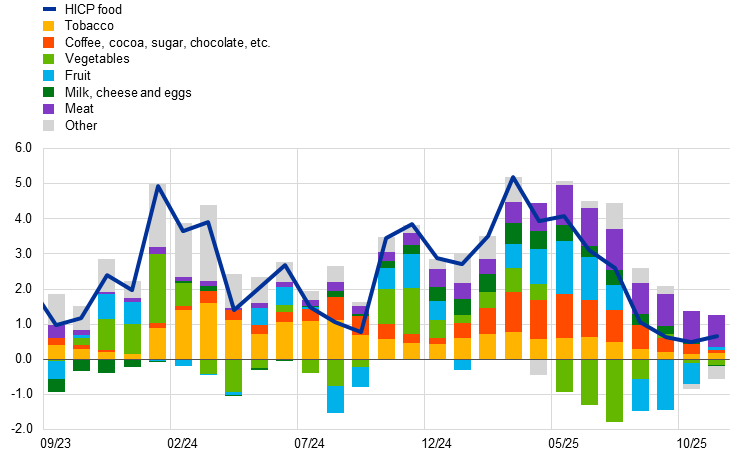
Food inflation has remained elevated this year, but this is mainly due to only a few items.[2] The annual rate of euro area HICP food inflation had declined to stand at 2.4% in November 2025, having peaked at 15.5% in March 2023. It averaged 2.9% in 2025 (January-November) and has remained above its pre-pandemic long-term average of 2.2% since December 2021. Among the different HICP food components, the main drivers of the above-average inflation rate in 2025 are “coffee, tea and cocoa”, “sugar, jam, honey, chocolate and confectionary” (sweets) and “meat”. In recent months, coffee, tea, cocoa, sweets and meat accounted for over 50% of the annual food inflation rate, despite having a weight of less than 25% in HICP food. By contrast, the contributions of the remaining food items have largely normalised since the 2022-23 inflation surge. Attention to food inflation in the media has also eased, but it remains higher than in 2019 (Chart B, panel a). More recently, month-on-month growth rates suggest easing price pressures for some items, for instance, coffee, tea, cocoa and sweets (Chart B, panel b), and annual rates have started to come back closer to their long-term average.
Chart B
HICP food inflation
a) HICP food inflation and media attention
(left-hand scale: annual percentage changes, percentage point contributions; right-hand scale: index)
b) Short-term price dynamics of HICP food
(3-month moving average of annualised month-on-month percentage changes, percentage point contributions)
Sources: Eurostat, Factiva and ECB calculations.
Notes: Based on 15 COICOP categories (mostly four-digit level). “Other” includes “Bread and cereals”, “Fish”, “Oils and fats”, “Food products n.e.c.”, “Mineral waters, soft drinks, fruit and vegetable juices”, “Spirits”, “Wine” and “Beer”. “Food inflation news coverage” is the monthly average of an updated underlying daily index as described by Aarab et al. (2025). The latest observations are for November 2025.
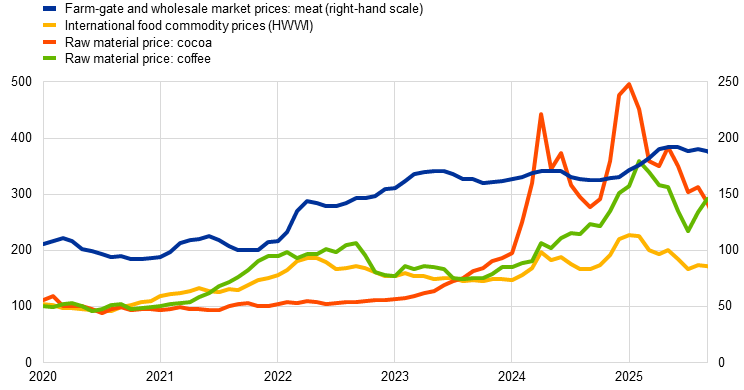
Food commodity prices have been important drivers of recent consumer food price increases, reflecting extreme weather events as well as other structural factors. Cocoa and coffee commodity prices reached new peaks in early 2025, having more than doubled since January 2024 (Chart C, panel a). While cocoa and coffee commodity prices have eased somewhat from their respective peaks, past increases have been passed through to consumer food prices with a delay. These increases can be partly attributed to extreme weather (Kotz et al., 2025). Similarly, findings from the ECB’s recent contacts with non-financial companies suggest that food price developments are also affected by climate change (Kuik et al., 2025). For example, we estimate that the 2025 summer heat wave could increase unprocessed food prices in the euro area by 0.4 to 0.7 percentage points after one year.[3] On the other hand, European meat (especially beef) prices have been driven by a continuing structural decline in supply, amid robust demand.[4] As such, European farm-gate prices for meat peaked in June 2025 – 17% higher than in January 2024 – before easing slightly thereafter.
Chart C
Drivers of HICP food inflation
a) Developments in food commodity prices
(indices, 2020 = 100)
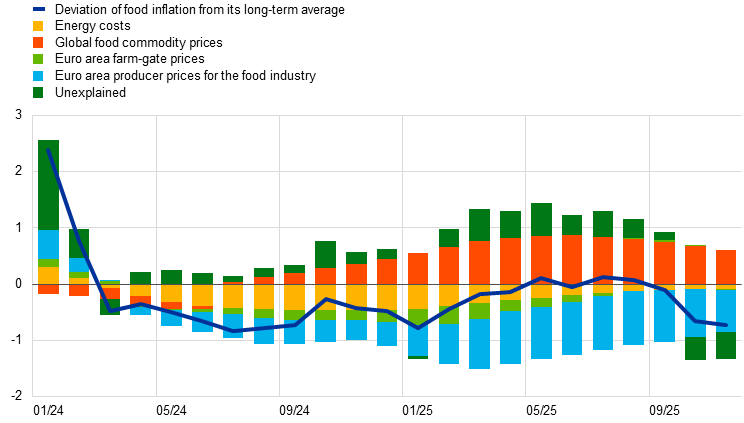
b) Model-based decomposition of HICP food inflation
(percentage point contributions to deviations from long-term averages)
Sources: Eurostat, European Commission, HWWI and ECB calculations.
Notes: In panel a), the latest observations are November 2025. In panel b), the chart shows a Bayesian Vector Autoregression-based decomposition of the drivers behind the deviation in euro area food inflation from its long-term average (and initial condition) using the ECB’s BEAR toolbox. Identification of the drivers follows the Cholesky decomposition outlined in Ferrucci et al. (2012), which imposes the following order of innovations: global food commodity prices (in euro, from HWWI), euro area producer prices for energy, euro area farm-gate prices, producer prices in the food sector, consumer prices. This ordering is consistent with the pricing chain assumption. The estimation sample is from December 1996 to November 2025.
A model-based decomposition of food inflation into its drivers also suggests that commodity prices have played a more important role recently (Chart C, panel b).[5] The decomposition shows a moderation of cost pressures in recent months on the back of slightly lower contributions from international commodity prices and a smaller (now negative) contribution from an “unexplained” component which may be linked to pass-through from past wage growth in the retail sector.[6] For example, the latest data on sectoral compensation per employee show that wage growth in the trade, transport, and accommodation sector – encompassing the food retail sector – remained elevated in the first half of 2025, above its pre-pandemic average.
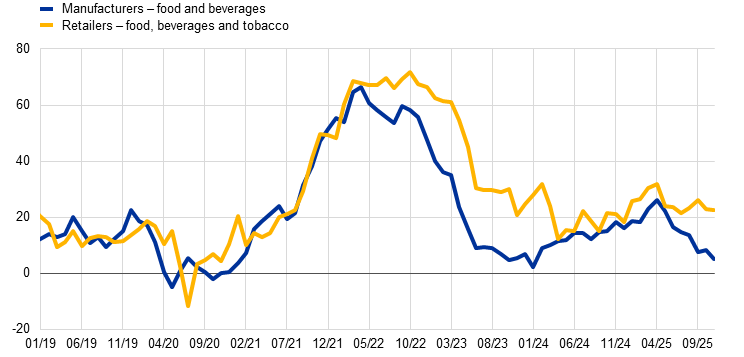
Looking ahead, food inflation is expected to ease further, supported in the near term by easing selling price expectations. The December 2025 Eurosystem staff macroeconomic projections for the euro area expect food inflation to decline in the short term, reaching 2.1% in the third quarter of 2026, and to remain at moderate levels throughout the rest of the projection horizon. In the very near term, this view is supported by manufacturers of food and beverages in the European Commission’s business survey, whose selling price expectations for the next three months have declined since April, falling below the long-term average observed between 1999 and 2019 (Chart D). In contrast, selling price expectations among retailers of food, beverages and tobacco moderated less markedly and have also remained above their long-term average, which could partly reflect the still elevated wage growth in this sector.
Chart D
Selling price expectations of food manufacturers and retailers – next three months
(percentage points, seasonally adjusted balances)
Source: European Commission.
Notes: Balances are constructed as the difference between the percentages of respondents giving positive and negative replies. The latest observation is for November 2025.
References
Aarab, I., Bańbura, M., Bobeica, E. and Leguay, E. (2025), “Monitoring attention to inflation in the news”, Economic Bulletin, Issue 6, ECB.
Bobeica, E., Koester, G. and Nickel, C. (2025), “When groceries bite: the role of food prices for inflation in the euro area”, The ECB Blog, ECB, 25 September.
D’Acunto, F., De Fiore, F., Sandri, D. and Weber, M. (2025), “A global survey of household perceptions and expectations”, BIS Quarterly Review, September 2025.
Ferrucci, G., Jiménez-Rodríguez, R. and Onorante, L. (2012), “Food Price Pass-Through in the Euro Area: Non-Linearities and the Role of the Common Agricultural Policy”, International Journal of Central Banking, Vol. 8, March 2012, pp. 179-218.
Kotz, M., Donat, M.G., Lancaster, T., Parker, M., Smith, P., Taylor, A. and Vetter, S.H. (2025), “Climate extremes, food price spikes, and their wider societal risks”, Environmental Research Letters, Vol. 20, No 8.
Kotz, M., Kuik, F., Lis, E. and Nickel, C. (2024), “Global warming and heat extremes to enhance inflationary pressures”, Nature Communications Earth & Environment, Vol. 5, No 115.
Kuik, F., Lis, E.M., Paredes, J. and Rubene, I. (2024), “What were the drivers of euro area food price inflation over the last two years?”, Economic Bulletin, Issue 2, ECB.
Kuik, F., Morris, R., Roma, M. and Slavík, M. (2025), “Main findings from the ECB’s recent contacts with non‑financial companies”, Economic Bulletin, Issue 7, ECB.
Legal Disclaimer:
EIN Presswire provides this news content "as is" without warranty of any kind. We do not accept any responsibility or liability for the accuracy, content, images, videos, licenses, completeness, legality, or reliability of the information contained in this article. If you have any complaints or copyright issues related to this article, kindly contact the author above.
